
Flood
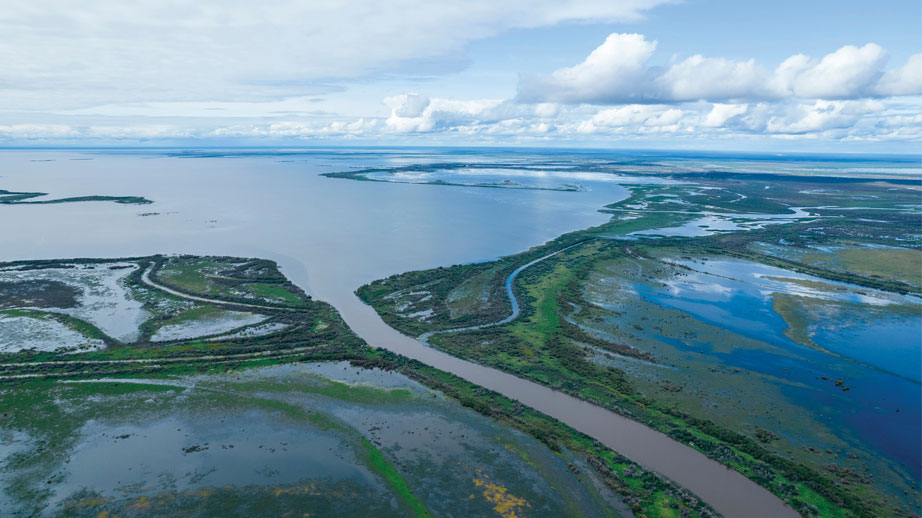
"An overflow of water onto lands that are used or usable by man and not normally covered by water. Floods have two essential characteristics: The inundation of land is temporary; and the land is adjacent to and inundated by overflow from a river, stream, lake, or ocean." (U.S. Geological Survey, 2019)
U.S. Geological Survey (USGS). "Water Science Glossary Terms". USGS Water Science School. (2019). Link: https://water.usgs.gov/edu/dictionary.html#W
Related Content
Article
Наводнения в Судане - Космический мониторинг наводнений для управления рисками стихийных бедствий
Translated by Marina Agarkova
В 2019 году наводнения стали причиной 43,5% всех смертей в результате стихийных бедствий и, таким образом, представляют собой самый смертоносный тип бедствия с растущим числом событий по сравнению с предыдущими годами (CRED, 2019). Кроме того, наводнения приводят к наибольшему числу пострадавших людей по сравнению с другими бедствиями, поскольку они влияют на деятельность человека и экономику (CRED, 2019; Elagib et al. 2019).
Наводнения в Судане - Космический мониторинг наводнений для управления рисками стихийных бедствий
Translated by Marina Agarkova
В 2019 году наводнения стали причиной 43,5% всех смертей в результате стихийных бедствий и, таким образом, представляют собой самый смертоносный тип бедствия с растущим числом событий по сравнению с предыдущими годами (CRED, 2019). Кроме того, наводнения приводят к наибольшему числу пострадавших людей по сравнению с другими бедствиями, поскольку они влияют на деятельность человека и экономику (CRED, 2019; Elagib et al. 2019).
Наводнения в Судане - Космический мониторинг наводнений для управления рисками стихийных бедствий
Translated by Marina Agarkova
В 2019 году наводнения стали причиной 43,5% всех смертей в результате стихийных бедствий и, таким образом, представляют собой самый смертоносный тип бедствия с растущим числом событий по сравнению с предыдущими годами (CRED, 2019). Кроме того, наводнения приводят к наибольшему числу пострадавших людей по сравнению с другими бедствиями, поскольку они влияют на деятельность человека и экономику (CRED, 2019; Elagib et al. 2019).
Capacity Building and Training Material
Event
Spatial droughts and floods: understanding, modelling, and prediction
"Spatial droughts and floods: understanding, modelling, and prediction" is part of The Topical Webinar Series hosted by the Core Modelling and Forecasting Team of the Global Water Futures program is a weekly event from May to August. In contrast to thematic webinars, this series highlights science advances from across the globe and aims to spur critical discussions that will improve our understanding and capability in modelling and managing cold-region hydrology.
To register, please email prabin.rokaya@usask.ca.
Local Perspectives Case Studies
Stakeholder
Person
Sawaid Abbas
Assistant Professor Smart Sensing for Climate and Development, GIS Centre, University of the Punjab Centre for Geographical Information, University of the Punjab
Sawaid is a spatial data scientist who works at the nexus of earth science, ecology and climate change through leveraging remote sensing, machine learning, and strong domain knowledge. His key work involves forest succession, drought, and rangelands which were accomplished through collaboration with institutions like WWF, ICIMOD, ICRAF, AFCD, and KFBG.
Bastian van den Bout
Assistant Professor University of Twente - Faculty ITC
Bastian van den Bout is a researcher at Twente University, and the founder of FastHazard, the spinoff company developing the FastFlood.org model. He has a passion to develop tools that allow for state-of-the-art flood technologies and models to be used easily in vulnerable communities. FastFlood.org and FastSlide.org are two recent models that link automatically with global datasets and allow for groundbreaking simulation speeds. His work has involved large-scale research projects, national-scale hazard mapping and education and supervision for students.
Hafsa Aeman
Senior Research Officer - Geoinformatics, CGIAR International Water Management Institute
Hafsa Aeman is a Senior Research Officer at the International Water Management Institute (IWMI) in Pakistan. In this capacity, she is deeply involved in various projects, notably the Water Resource Accountability in Pakistan (WRAP) and NEXU Gains initiatives, both supported by the UK Foreign, Commonwealth, and Development Office (FCDO). These projects are geared towards augmenting capacity for water resource management at the provincial and district levels.
Benjamin Wullobayi Dekongmen
PhD Candidate University of Energy and Natural Resources
Benjamin is a poised and passionate Geospatial enthusiast and Environmental Hydrologist with a strong research focus on Groundwater Recharge, Flood Risks Terrain and Climate Change modelling. He has a wide range of expertise in GIS and Remote Sensing, Soil and Water Assessment Tool (SWAT), Python, and Google Earth Engine.