
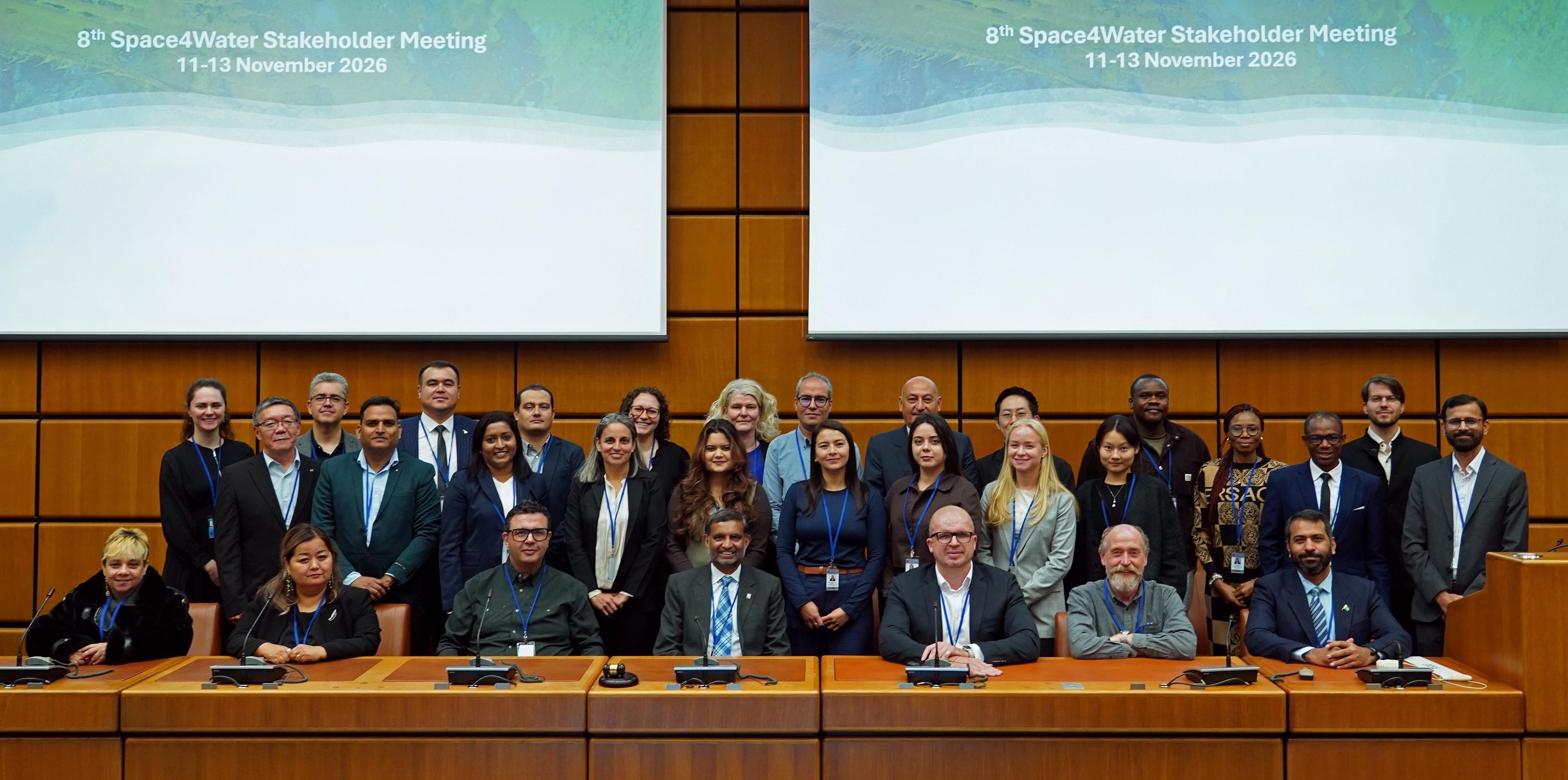
8th Space4Water Stakeholder Meeting | 11–13 November 2026 | Vienna, Austria
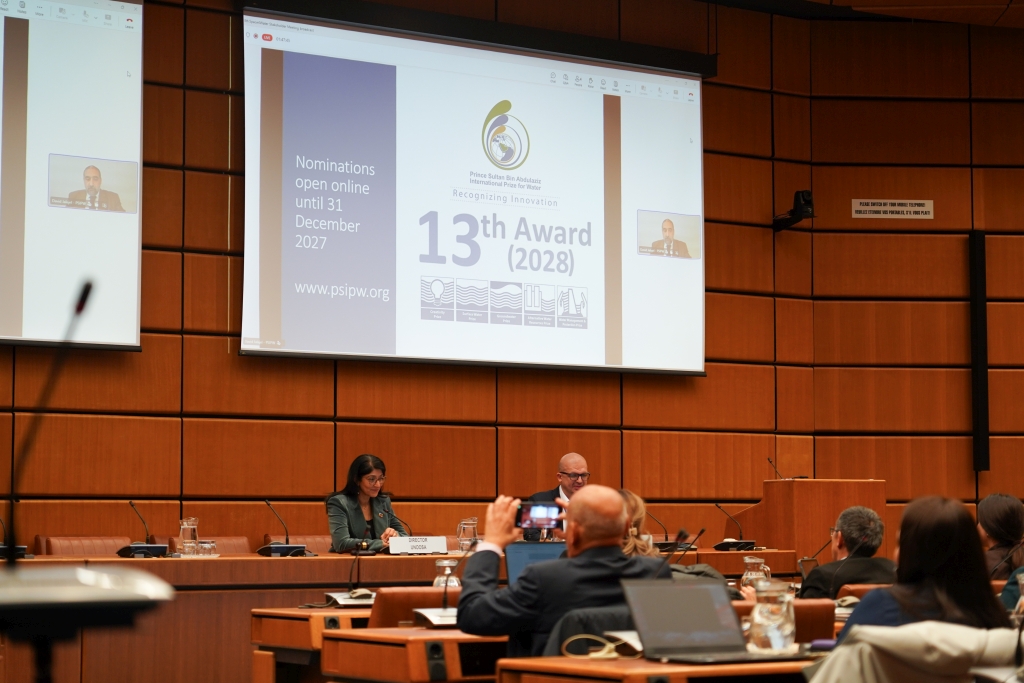
The United Nations Office for Outer Space Affairs (UNOOSA) convened the 8th Space4Water Stakeholder Meeting from 11 to 13 November 2026 in Vienna, bringing together more than 50 participants in person, with a much broader audience joining selected sessions online. Participants represented national water and disaster-management authorities, space agencies, academia and research institutions, the United Nations system, industry, the private sector and young professionals. The meeting also welcomed many new members and contributors to the Space4Water community. The meeting was held with the support of the Prince Sultan Bin Abdulaziz International Prize for Water (PSIPW).
From data and research to water-management decisions
A central theme throughout the three days was how to move from Earth-observation data, scientific research and technical capabilities to information and solutions that can be integrated into real water-management decisions and institutional processes.
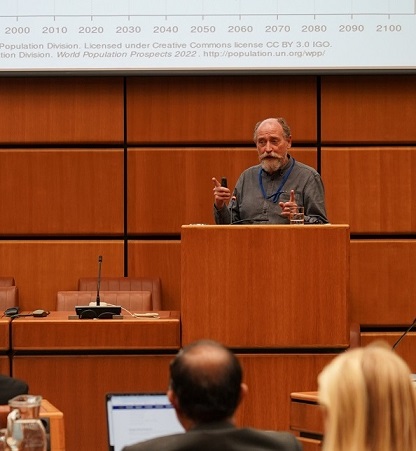
The opening keynote by Dr Alan Belward, formerly of the European Commission Joint Research Centre, considered how new information flows are shaping water-management strategies and helped frame a recurring question throughout the meeting: how can scientific and technological advances be translated into information that is operationally useful? The discussions emphasized a user-driven approach: starting from the decision that needs to be made and the information required, identifying existing gaps, and then considering where satellite data, geospatial tools and other space-based capabilities can add value.
The meeting also connected these discussions with the wider United Nations water agenda. A contribution from Natalie Degger, UN-Water and UN-Oceans Focal Point at UNIDO, provided the perspective of UN-Water, the United Nations inter-agency coordination mechanism on water and sanitation. The discussion explored opportunities to strengthen connections between space-based capabilities, water-sector needs and wider UN efforts on water (UNOOSA is a member of UN-Water).
The meeting highlighted applications across a wide range of water-related challenges, including floods and droughts, groundwater, agricultural water use and irrigation, wetlands, urban water management, sea-level rise, rainwater and runoff harvesting, water quality, land and pasture management, watershed resilience and disaster-risk reduction.
Connecting regional challenges with space-based expertise
A particular focus was the Central Asia Water and Land Nexus (CAWLN) for Ecosystem Restoration, Improved Natural Resource Management and Increased Resilience project, funded by the Global Environment Facility and implemented with UNOOSA participation. CAWLN was introduced as a concrete challenge around which Space4Water expertise could be mobilized, connecting regional water- and land-management needs with Earth-observation data, analytical approaches, technologies and potential partners.
Related contributions addressed the Amu Darya and Syr Darya basins, hazard monitoring in the Kyrgyz Republic, satellite-based agricultural water management in Uzbekistan and sustainable pasture management in Central Asia, illustrating how space-based information can support both national and transboundary challenges. A further challenge introduced by UNIDO explored how Space4Water expertise could contribute to resilient industrial development.
Community challenges and solutions
A substantial part of the meeting was dedicated to Space4Water community members working on concrete challenges and sharing solutions developed through thematic collaboration. Topics included irrigation-demand forecasting, wetland monitoring, drought and water scarcity, multi-hazard mapping, land-use and land-cover change, urban stormwater management, sea-level rise, rainwater harvesting and satellite-based monitoring of water quantity and quality.
The discussions went beyond the presentation of technical results to consider what is required for solutions to move towards practical use, including access to data, validation, institutional capacity, user involvement, trust, partnerships and integration into existing workflows. A dedicated roundtable on “From Research to Impact” examined barriers to the operational uptake of research, data and technical solutions and explored opportunities for further collaboration across the community.
Connecting space and water policy
In cooperation with the European Space Policy Institute (ESPI), the meeting featured a dedicated Space and Water Policy Dialogue. The session included a presentation of ESPI's report Converging Currents – Recommendations to Align Space and Water Policy Agendas in Europe and an interactive workshop examining how space capabilities can be better aligned with freshwater-policy priorities. The discussion complemented the technical sessions by emphasizing that successful uptake of space-based solutions also depends on policy frameworks, institutional arrangements and the co-design of solutions with water-sector actors.
Emerging technologies and wider access
The final day highlighted emerging technologies and approaches for water management, including satellite-based lidar, radar-based groundwater assessment, machine learning, geospatial platforms and improved access to satellite imagery, tools and training. Contributions also examined how access to high-quality satellite data can enable water-management projects while recognizing that data itself is only one part of the solution: its value depends on how it is combined with user expertise, local knowledge and institutional decision-making processes.
Strengthening the Space4Water community
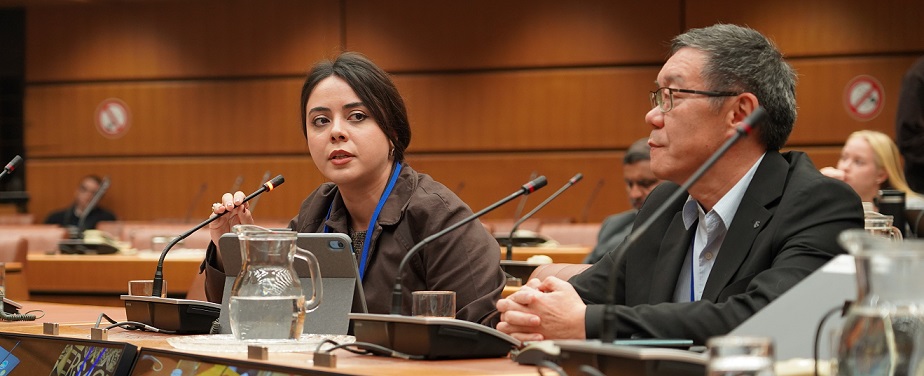
The meeting also provided an opportunity to discuss how the Space4Water community can remain active and connected between annual stakeholder meetings. Participants explored ways to strengthen existing thematic collaboration while also considering more flexible, challenge-oriented and member-led approaches. Particular attention was given to developing stronger horizontal links among community members and creating pathways from knowledge exchange towards concrete cooperation.
The strong interest in the meeting, including more than 300 applications and expressions of interest, reflected growing demand for a community connecting water-management needs with space-based data, technologies and expertise. The discussions and feedback gathered in Vienna will inform the further development of Space4Water activities and priorities for the coming year.
Meeting resources
UNOOSA thanks all participants, speakers, and contributors for their active engagement; the Prince Sultan Bin Abdulaziz International Prize for Water (PSIPW) for its continued support of the Space4Water initiative; and the European Space Policy Institute (ESPI) for its active contribution to the meeting.


